

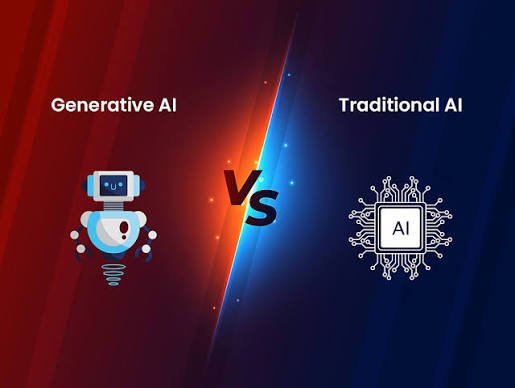
Generative AI vs. Traditional AI is an important comparison for enterprises deciding how to use artificial intelligence to improve efficiency, automate workflows, and support better business decisions. Although both approaches rely on machine learning and data, they serve different purposes. Traditional AI primarily analyzes existing information, identifies patterns, predicts outcomes, and classifies data. Generative AI goes a step further by creating new content, such as text, images, code, summaries, and synthetic data, based on patterns learned during training.
As organizations accelerate their AI adoption, understanding these differences is essential for selecting the right technology for each business problem. A financial services company may use traditional AI to detect fraudulent transactions while applying generative AI to summarize investigation reports. A manufacturing enterprise may use predictive models to anticipate equipment failures and generative AI to help engineers interpret maintenance documentation. In many cases, the greatest value comes not from choosing one approach over the other, but from combining them within a well-governed enterprise AI strategy.
What Is Traditional AI?
Traditional AI refers to AI systems designed to perform specific tasks by analyzing data, recognizing patterns, applying rules, or predicting likely outcomes. These systems often use techniques such as supervised learning, unsupervised learning, classification, regression, clustering, optimization, and rule-based reasoning.
Traditional AI is particularly effective when an organization has a clearly defined objective and structured data that can support reliable analysis. For example, a bank can train a machine learning model to identify suspicious transactions based on historical fraud patterns. A retailer can forecast product demand using sales history, seasonal trends, pricing, and inventory data. An HR team can use analytics models to estimate workforce demand or identify patterns in employee attrition, subject to appropriate fairness and privacy safeguards.
The output of a traditional AI system is usually a prediction, classification, score, recommendation, or decision-support signal rather than newly created content. A model might classify a support ticket as a billing issue, estimate the probability of a customer cancelling a subscription, or flag a machine for preventive maintenance.
Traditional AI can include simple rule-based systems as well as sophisticated deep learning models. Therefore, it should not be treated as synonymous with older technology. Many modern fraud detection, computer vision, recommendation, and forecasting systems use advanced machine learning techniques while still focusing on analysis and prediction.
What Is Generative AI?
Generative AI refers to AI systems designed to produce new content based on patterns learned from training data. These systems commonly use deep learning architectures, including transformer-based large language models and diffusion models for image generation. Depending on the model, they can generate text, software code, images, audio, video, and other forms of content.
Unlike a traditional classification model that determines whether a support ticket relates to billing or a technical problem, a generative AI system can draft a response to the ticket, summarize the customer’s issue, or suggest troubleshooting steps. Similarly, it can turn a long business report into an executive summary, explain a complex technical concept, or help developers create a first draft of a software function.
Generative AI is especially useful when tasks involve language, interpretation, synthesis, and content creation. It can help employees work with unstructured information such as emails, contracts, policies, meeting transcripts, product documentation, and customer conversations.
However, generative AI does not guarantee factual accuracy. Models may produce plausible-sounding but incorrect information, misunderstand context, or omit important details. Enterprises therefore need appropriate validation, access controls, human review, and evaluation processes before relying on generated outputs in consequential workflows.
Generative AI vs. Traditional AI: Key Differences
The most important difference between the two approaches is their primary objective. Traditional AI generally evaluates available information to predict, classify, or optimize an outcome, while generative AI creates new content or representations based on learned patterns. Their underlying techniques can overlap, but their typical outputs and operating requirements often differ.
| Comparison Factor | Traditional AI | Generative AI |
|---|---|---|
| Primary purpose | Analyze data, classify information, predict outcomes, and optimize decisions | Generate new content and synthesize information |
| Typical outputs | Scores, predictions, categories, rankings, and alerts | Text, summaries, images, code, audio, and other generated content |
| Common techniques | Decision trees, regression, gradient boosting, clustering, and predictive neural networks | Large language models, transformers, diffusion models, and other generative architectures |
| Typical data | Often structured or task-specific data, although it can also process unstructured data | Often large collections of text, images, audio, code, or other content |
| Common use cases | Fraud detection, demand forecasting, predictive maintenance, and churn prediction | Content generation, conversational assistants, document summarization, and code assistance |
| Evaluation | Accuracy, precision, recall, error rates, calibration, and business outcomes | Factuality, relevance, coherence, task completion, safety, and business outcomes |
| Predictability | Can be relatively consistent for well-defined tasks, depending on the model and inputs | Outputs may vary across prompts and runs, depending on model settings and design |
| Key risks | Bias, poor data quality, model drift, and incorrect predictions | Hallucinations, data leakage, prompt injection, copyright concerns, and inconsistent outputs |
| Human oversight | Needed for important or uncertain predictions and decisions | Particularly important when generated content affects customers, compliance, or high-impact decisions |
| Enterprise value | Improves prediction, classification, optimization, and decision support | Improves content creation, knowledge access, communication, and language-intensive workflows |
These distinctions are useful guidelines rather than absolute boundaries. Traditional AI can generate outputs such as recommendations or synthetic data, and generative AI can perform classification and extraction tasks. The right choice depends on the problem, the required reliability, the available data, and the consequences of an incorrect result.
How Traditional AI Works in Enterprise Environments
Traditional AI typically starts with a clearly defined business problem, a suitable dataset, and an outcome that can be measured. Data scientists and engineers prepare historical data, select relevant features, train or configure a model, and evaluate its performance against an appropriate baseline.
Once deployed, the model receives new data and produces a prediction or classification. Its performance is monitored over time because changing customer behavior, market conditions, operating processes, or data quality can reduce its accuracy. Depending on the use case, teams may need to retrain the model, adjust decision thresholds, or investigate unexpected results.
For example, a logistics company may train a model to estimate delivery delays using route information, weather conditions, warehouse activity, and historical shipment records. The model can help operations teams prioritize shipments that are likely to arrive late. Its effectiveness can be measured using prediction error, on-time delivery rates, and the cost of corrective actions.
Traditional AI is especially valuable when the business needs repeatable outputs, measurable performance, and decisions based on well-defined signals. It is often the stronger starting point for forecasting, risk scoring, anomaly detection, and many optimization problems.
How Generative AI Works in Enterprise Environments
Generative AI systems learn patterns from training data and use those patterns to create new outputs in response to an input, commonly called a prompt. Modern enterprise applications may combine a foundation model with additional components such as retrieval-augmented generation (RAG), enterprise search, application programming interfaces (APIs), workflow automation, and access to approved business tools.
Consider an enterprise employee who needs to understand a complex internal policy. A generative AI assistant can retrieve relevant policy documents, summarize the applicable sections, and explain them in plain language. With retrieval-augmented generation, the system can use selected source material to ground its response rather than relying exclusively on information encoded in the model’s training.
This approach can make organizational knowledge easier to access, but retrieval does not eliminate every error. The system may select incomplete documents, misinterpret a passage, or generate a response that goes beyond the available evidence. Effective deployments should provide source references where appropriate, enforce document permissions, and test answers against representative questions.
Generative AI can also be integrated with business tools to perform multi-step tasks. For example, an assistant might summarize a customer request, retrieve account information, draft a response, and prepare a CRM update for approval. When a system can plan and execute actions through connected tools, it may form part of an agentic AI workflow. Such workflows need stronger safeguards because a generated mistake can become an operational action.
Enterprise Use Cases for Traditional AI
Traditional AI continues to deliver significant value across enterprise functions, especially where prediction and structured decision support are central to the workflow.
1. Fraud Detection and Risk Scoring
Financial institutions use machine learning models to analyze transaction patterns, device signals, account behavior, and other relevant indicators. The models assign risk scores or flag suspicious activity for additional review. This helps fraud teams prioritize investigations and respond more quickly to potential threats.
The system’s effectiveness depends on the quality and relevance of its data, the balance between missed fraud and false alarms, and how well it adapts to changing fraud patterns. Human investigators and additional verification controls remain important for high-impact decisions.
2. Predictive Maintenance in Manufacturing
Manufacturers can use sensor readings, maintenance logs, operating conditions, and equipment history to estimate the probability of component failure. Predictive models help maintenance teams identify equipment that may require attention before a breakdown disrupts production.
This approach can reduce unplanned downtime and improve maintenance planning. Results depend on sensor reliability, equipment variation, model quality, and the organization’s ability to act on warnings.
3. Demand Forecasting and Inventory Optimization
Retailers and supply chain organizations use traditional AI to forecast demand based on sales history, promotions, pricing, seasonality, and external factors. Forecasts support replenishment decisions, inventory allocation, and warehouse planning.
The models may be updated as market conditions change. Businesses should evaluate forecasting error alongside operational outcomes such as stockouts, excess inventory, and fulfillment costs rather than relying on model accuracy alone.
4. Customer Churn Prediction
Subscription businesses, telecom providers, and software companies can analyze usage trends, service interactions, payment history, and customer engagement to identify accounts that may be at risk of leaving.
The resulting scores help customer success teams prioritize outreach and design retention campaigns. Predictions should guide investigation and support rather than automatically determine how a customer is treated.
5. Cybersecurity Anomaly Detection
Traditional AI can analyze authentication activity, network traffic, endpoint events, and application logs to detect patterns that differ from expected behavior. These models help security teams identify potential intrusions, compromised accounts, and unusual activity.
Because unusual behavior is not always malicious, effective security operations combine model alerts with contextual investigation, threat intelligence, and response policies.
Enterprise Use Cases for Generative AI
Generative AI is most valuable when employees spend substantial time reading, writing, interpreting, summarizing, or creating content. It can also make business knowledge more accessible when connected to trusted information sources.
1. Customer Service and Conversational Support
Generative AI assistants can interpret customer questions, summarize previous interactions, draft responses, and guide users through troubleshooting steps. When integrated with approved knowledge bases, they can help service teams respond consistently and reduce the effort required to locate relevant information.
A well-designed deployment should identify when an issue requires a human agent, restrict access to customer data, and evaluate response quality. Billing changes, account closures, refunds, and other consequential actions should follow defined authorization and confirmation rules.
2. Software Development and IT Operations
Development teams use generative AI to draft code, explain unfamiliar functions, produce unit-test suggestions, document APIs, and help investigate errors. IT teams can use it to summarize incident reports, explain runbook procedures, and create first drafts of technical documentation.
These tools can reduce repetitive work, but generated code still requires testing, security review, dependency checks, and human judgment. In IT operations, suggestions that can change production systems should be separated from approved execution workflows.
3. Enterprise Knowledge Management
Large organizations often store valuable information across policies, project documents, support tickets, technical manuals, and internal collaboration platforms. Employees may struggle to find the right material or interpret long documents.
Generative AI can summarize this content, answer natural-language questions, and produce responses grounded in approved documents. Enterprise search and RAG can improve access to current internal information, provided the underlying documents are well managed and the assistant respects existing permissions.
4. Marketing and Sales Enablement
Marketing teams can use generative AI to draft campaign variations, adapt content for different audiences, summarize customer research, and develop initial versions of email sequences or product descriptions. Sales teams can summarize calls, prepare account briefs, and tailor outreach based on approved customer information.
Human review remains necessary to maintain brand voice, verify claims, protect confidential information, and avoid producing generic or misleading communications. Generative AI is best used to accelerate drafting and research rather than eliminate editorial accountability.
5. Document Processing and Business Operations
Enterprises manage large volumes of contracts, invoices, proposals, compliance documents, and operational reports. Generative AI can extract relevant information, summarize clauses, explain differences between document versions, and prepare structured outputs for downstream review.
For high-volume or regulated workflows, the system should validate extracted fields, preserve links to source documents, and route uncertain results for human verification. Traditional extraction models, rules, and database validation can complement generative AI to improve reliability.
6. HR Support and Employee Experience
HR teams can use generative AI to help employees find policy information, draft internal communications, summarize learning materials, and prepare role descriptions. An assistant connected to approved HR documentation can make routine information easier to access.
However, employee data requires strong access controls and privacy safeguards. Generative AI should not be allowed to make unreviewed high-impact employment decisions, and organizations should test systems for biased or inconsistent responses.
Combining Generative AI and Traditional AI: A More Effective Enterprise Strategy
Enterprises do not need to treat generative AI and traditional AI as competing alternatives. In many business workflows, one technology identifies what is happening while the other helps people understand or act on the result.
Consider a predictive maintenance workflow in a manufacturing organization. A traditional machine learning model analyzes sensor readings and estimates the risk of equipment failure. When the risk exceeds a defined threshold, a generative AI assistant retrieves relevant maintenance manuals, summarizes the previous service history, and drafts an inspection checklist for a technician. The predictive model provides the risk signal, while generative AI helps translate that signal into useful operational context.
A similar pattern can improve fraud investigations. Traditional AI flags suspicious transactions based on defined risk indicators. Generative AI then summarizes the evidence, organizes relevant case notes, and drafts an investigation report for an analyst. The generative system should not invent evidence or independently make a consequential decision based on an unverified summary.
A practical combined architecture may include:
- Traditional AI models for predictions, classification, risk scoring, anomaly detection, and optimization.
- Generative AI models for summarization, explanation, content creation, and natural-language interaction.
- Enterprise data platforms for governed access to structured and unstructured information.
- Integration and orchestration layers for connecting models to business applications and approved tools.
- Governance and monitoring controls for evaluating outputs, enforcing permissions, recording actions, and managing risk.
This approach allows organizations to use each technology where it is most effective while maintaining appropriate boundaries around reliability and accountability.
How to Choose the Right AI Approach for Your Business
Selecting the right approach begins with the business outcome rather than the popularity of a particular technology. Enterprises should determine whether the problem primarily requires a prediction, a classification, an optimization decision, content generation, or a combination of these capabilities.
If the objective is to forecast demand, detect fraud, predict equipment failure, or estimate customer churn, traditional AI is often an appropriate starting point. These tasks have measurable outcomes and can frequently be evaluated against historical data and operational baselines.
If the objective is to summarize contracts, answer questions about internal documentation, draft customer communications, or assist with code, generative AI may be a better fit. These tasks involve language, synthesis, and content creation, although they still require suitable evaluation methods.
Organizations should also assess data readiness, privacy, implementation costs, latency, integration complexity, and the consequences of failure. A simpler rules-based system or conventional software workflow may be sufficient for some problems. AI should be introduced when it offers a measurable advantage over the available alternatives.
Before deployment, teams should define success metrics, establish a test dataset, evaluate failure modes, and determine where human approval is required. A pilot should demonstrate business value under realistic operating conditions before the organization expands it across additional teams or processes.
Risks and Governance Considerations
Both traditional AI and generative AI introduce risks that must be managed throughout the model lifecycle. Traditional models may produce biased predictions, degrade as business conditions change, or behave poorly when deployed on data that differs from their training environment. Generative models may hallucinate information, expose sensitive data, follow malicious instructions embedded in retrieved content, or produce unsafe or misleading outputs.
Governance should match the type of risk involved. Traditional AI systems may require ongoing checks for predictive performance, calibration, bias, and model drift. Generative AI systems require additional evaluation of factual accuracy, groundedness, instruction handling, prompt injection resistance, content safety, and consistency across different inputs.
Enterprise controls should include approved data sources, least-privilege access, encryption, logging, retention rules, testing, incident response, and clear accountability. Systems connected to external tools should use permission checks and explicit approval gates for consequential actions. Human oversight should be proportional to the impact of an error, with stronger controls for financial, legal, security, and employment-related decisions.
Organizations should also monitor total cost of ownership. Generative AI usage can involve inference costs, retrieval infrastructure, evaluation, and ongoing quality review, while traditional AI can require feature engineering, specialized data pipelines, and model maintenance. The right comparison includes the cost of the complete workflow and the business value it delivers.
The Future of Enterprise AI
Enterprise AI is moving toward systems that combine prediction, generation, retrieval, and controlled action. Traditional AI will continue to support forecasting, optimization, risk management, and other tasks where measurable outcomes are essential. Generative AI will expand how employees interact with information, create content, and work with complex knowledge.
As models become integrated with enterprise applications, businesses will increasingly design workflows in which different AI capabilities collaborate. A customer service platform may use traditional models to prioritize cases, generative AI to draft responses, and rules-based controls to approve refunds. An IT operations platform may detect an anomaly, retrieve the relevant runbook, and prepare a remediation plan for an engineer to review.
This shift makes governance and system design more important, not less. Enterprises will need to understand where information originates, how outputs are evaluated, which actions models can perform, and when human judgment must take precedence. The organizations that succeed will be those that align AI capabilities with clearly defined business needs and establish reliable processes for monitoring results.
Conclusion
Generative AI and Traditional AI serve different but complementary purposes in enterprise environments. Traditional AI is especially effective at analyzing data, identifying patterns, predicting outcomes, and supporting measurable decisions. Generative AI is particularly useful for creating content, summarizing information, answering questions, and assisting with language-intensive work.
The right choice depends on the problem being solved, the quality of available data, the required level of reliability, and the potential consequences of an incorrect output. Many organizations will achieve the greatest value by combining both approaches within governed business workflows.
Rather than adopting AI simply to follow a trend, enterprises should begin with a specific operational challenge, define measurable success criteria, test the available approaches, and scale what works. With the right architecture, oversight, and integration strategy, traditional AI and generative AI can help organizations improve productivity, strengthen decision-making, and build more intelligent business operations.
