

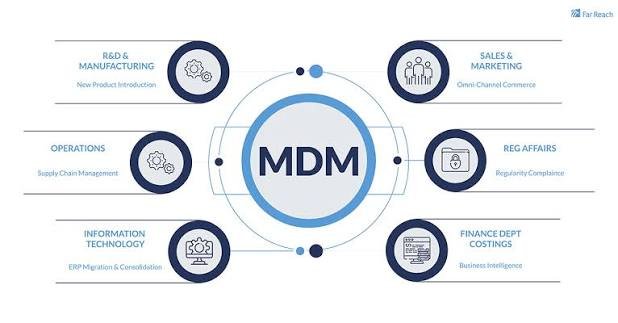
Master Data Management (MDM) helps organizations improve data consistency across systems by creating a reliable, unified view of critical business information. Modern enterprises rely on multiple applications to manage customers, products, suppliers, employees, locations, and financial operations. When these systems store conflicting or duplicated information, businesses face reporting errors, inefficient workflows, poor customer experiences, and costly operational problems. MDM addresses these challenges by establishing trusted master records, standardizing data definitions, and ensuring that the right information is available across the organization.
As organizations adopt cloud platforms, enterprise resource planning (ERP) systems, customer relationship management (CRM) tools, human resource information systems (HRIS), and analytics platforms, maintaining consistent data becomes increasingly important. A well-designed MDM strategy connects these systems through shared data standards, governance policies, and integration processes. Rather than forcing every application to operate independently, MDM helps businesses build a dependable foundation for automation, analytics, regulatory compliance, and digital transformation.
What Is Master Data Management (MDM)?
Master Data Management is a combination of technology, processes, policies, and governance practices used to create and maintain consistent, accurate, and trusted records of an organization’s most important business entities. These records, known as master data, describe core objects that multiple departments and applications need to reference.
For example, a company may store customer information in its CRM, billing platform, customer support application, and marketing automation system. If each application maintains its own version of a customer’s name, address, account status, or company details, employees may struggle to determine which record is correct. MDM establishes rules for identifying, matching, validating, and maintaining these records so that the organization can work from a more consistent source of information.
MDM is not simply a database consolidation project. It does not necessarily require moving all business data into one physical repository. Instead, it establishes a trusted way to manage core records and distribute or expose them to the systems that need them. Depending on the architecture, an MDM solution may use a centralized master repository, a registry that links records across systems, or a hybrid approach.
The primary goal is to make critical business data accurate, understandable, reusable, and consistently governed across the enterprise.
Why Data Consistency Is a Major Enterprise Challenge
Data inconsistency often develops gradually as organizations introduce new applications, acquire businesses, expand into new markets, and create department-specific workflows. Each system may use different naming conventions, identifiers, formats, and validation rules. Over time, these differences create data silos that prevent teams from developing a shared understanding of the business.
Consider a global organization that operates separate sales, finance, logistics, and customer service platforms. The sales team may identify a customer using an account name, while finance uses a billing identifier and logistics relies on a delivery location. Without a consistent relationship between these records, the organization may struggle to reconcile orders, invoices, customer interactions, and shipments.
Several common problems contribute to this challenge.
Duplicate records: The same customer, supplier, or product may appear multiple times under slightly different names or identifiers. Duplicates can distort reporting and create unnecessary administrative work.
Conflicting information: A customer’s address may be updated in one application but remain outdated in another. This can lead to failed deliveries, incorrect invoices, and inconsistent communications.
Different data standards: Applications may use different formats for dates, currencies, country names, product categories, and employee identifiers. Integrating these records requires additional transformation and validation.
Unclear ownership: When multiple departments can modify the same business information, employees may not know which team is responsible for resolving discrepancies or approving changes.
Limited visibility: Fragmented master data makes it difficult to build accurate reports, analyze business performance, and understand relationships across systems.
Master Data Management addresses these problems by introducing shared definitions, data quality rules, ownership responsibilities, and controlled methods for synchronizing important records.
Types of Master Data Managed by MDM
The scope of an MDM program depends on the organization’s industry, operating model, and technology landscape. Most initiatives begin with one or two high-value data domains before expanding across the enterprise.
1. Customer Master Data
Customer master data includes names, contact details, account identifiers, addresses, business relationships, and customer classifications. Maintaining consistent customer records helps sales, marketing, finance, and customer service teams recognize the same customer across their applications.
For B2B organizations, this may also involve connecting individual contacts to parent companies, subsidiaries, and business units. A reliable customer master can improve account planning, reduce duplicate outreach, and support more accurate revenue reporting.
2. Product Master Data
Product master data includes product identifiers, descriptions, categories, units of measurement, specifications, and lifecycle status. Manufacturers, distributors, retailers, and ecommerce businesses need consistent product information to coordinate procurement, inventory, sales, and fulfillment.
For example, a product may have different descriptions in an ERP system, ecommerce catalog, and warehouse management application. MDM helps standardize product attributes and establish relationships between internal identifiers and external catalog references.
3. Supplier and Vendor Master Data
Supplier master data includes vendor names, addresses, tax identifiers, payment details, contract references, and approved supplier status. Inconsistent supplier records can result in duplicate vendor payments, fragmented procurement reporting, and increased compliance risks.
A trusted supplier master helps procurement and finance teams identify duplicate registrations, enforce validation rules, and maintain consistent supplier information across purchasing and payment systems.
4. Employee Master Data
Employee master data covers employee identifiers, names, organizational assignments, job information, manager relationships, and employment status. It supports consistent information exchange among HRIS, payroll, benefits, identity management, and workforce planning systems.
Because employee information can be sensitive, MDM for employee data must also incorporate access controls, privacy requirements, and clear restrictions on which systems and users can access particular attributes.
5. Location and Financial Reference Data
Organizations may also manage master records for offices, warehouses, legal entities, cost centers, business units, and operating locations. Financial reference data, such as account structures and organizational hierarchies, may be managed through related governance processes or specialized master data capabilities.
Standardizing these records helps businesses consolidate financial reporting, compare performance across regions, and maintain consistent organizational structures.
How Master Data Management Improves Data Consistency Across Systems
MDM improves consistency by establishing a controlled process for creating, validating, matching, maintaining, and sharing trusted master records.
Creating a Trusted Master Record
The first step is identifying which system or process should be authoritative for each data attribute or business entity. An organization might use its CRM as the primary source for certain sales account attributes, while finance controls billing information and an HRIS governs employee employment records.
An MDM platform can combine information from multiple sources to create a consolidated record, often referred to as a golden record. This record represents the most reliable available version of a business entity based on defined matching, survivorship, and governance rules.
A golden record does not mean that every field must come from the same application. For example, a customer name may come from a verified account record, while a billing address comes from a finance-approved source. The organization defines how conflicts are resolved and which values take precedence.
Identifying and Resolving Duplicate Records
MDM solutions use matching rules to identify records that may refer to the same real-world entity. Matching can use exact identifiers, standardized names, addresses, contact details, and other relevant attributes. More advanced approaches may use probabilistic matching or machine learning to identify less obvious similarities.
When potential duplicates are identified, the system can automatically merge high-confidence matches or send uncertain cases to a data steward for review. Merge policies must preserve important relationships and maintain traceability so that downstream systems can continue to recognize the correct entity.
This process improves consistency without assuming that every similar record represents the same customer, product, or supplier.
Standardizing Data Definitions and Formats
Different applications frequently represent the same information in different ways. One system may store a country as an abbreviation, another as a full name, and a third using a numeric code. MDM introduces common standards and transformation rules to normalize these differences.
Standardization may cover address formats, date conventions, units of measurement, product classifications, naming rules, and required fields. When these standards are applied consistently, systems can exchange data with fewer errors and less manual intervention.
Synchronizing Changes Across Applications
After a master record is created or updated, the relevant changes must reach the systems that depend on it. MDM architectures may distribute updates through APIs, event-driven messaging, scheduled integrations, or other synchronization mechanisms.
For example, when an approved supplier address changes, the updated information may need to flow to procurement, accounts payable, contract management, and logistics applications. Synchronization rules determine which attributes are shared, which systems may update them, and how failures or conflicting changes are handled.
Not every change needs to be distributed immediately. Some organizations require real-time updates, while others can use scheduled synchronization based on business needs and system capabilities.
Establishing Data Governance and Accountability
Technology alone cannot guarantee consistency. MDM needs clear governance rules that define who owns each data domain, who can approve changes, and how data quality issues are resolved.
Data owners establish policies and business definitions, while data stewards oversee data quality, investigate exceptions, and coordinate corrections. Technical teams maintain integrations, validation services, access controls, and monitoring.
This shared operating model helps ensure that data quality remains a continuous business responsibility rather than a one-time cleanup exercise.
MDM Architecture: Common Approaches to Managing Master Data
Organizations can implement MDM using different architectural patterns. The right choice depends on data latency requirements, system complexity, existing platforms, and how much control the business needs over master records.
| MDM Architecture | How It Works | Key Advantage | Main Consideration |
|---|---|---|---|
| Consolidation | Data is collected from multiple systems into a central repository for matching and analysis. | Creates a unified view for reporting and analytics. | Changes may not automatically update source systems. |
| Registry | A central index links related records while detailed data remains in source systems. | Reduces the need to physically centralize all data. | A unified view depends on source availability and integration quality. |
| Coexistence | Master data is maintained centrally and synchronized with participating applications. | Supports shared master records across operational systems. | Requires careful synchronization and conflict management. |
| Centralized or transactional | A central MDM hub controls master record creation and distributes approved records to connected systems. | Provides stronger control over creation and maintenance. | Requires broader process changes and well-managed integrations. |
These patterns are not always mutually exclusive. Enterprises may use a consolidation approach for analytics while using centralized control for selected operational domains. Some platforms also combine elements of multiple architectures.
The most suitable design is the one that balances governance, reliability, operational complexity, and the organization’s actual need for consistent data.
Key Benefits of Master Data Management
Better Operational Efficiency
When employees no longer need to reconcile conflicting records manually, routine business processes become more efficient. Teams can spend less time investigating duplicate customers, correcting supplier details, and resolving inconsistencies between applications.
Automated validation and controlled data distribution can also reduce errors in order processing, invoicing, employee onboarding, and inventory management.
More Reliable Business Intelligence
Analytics depends on consistent definitions and trustworthy records. If a company counts the same customer multiple times or uses inconsistent product identifiers across systems, its reports may present a misleading view of performance.
MDM improves the reliability of business intelligence by helping analytics teams work with standardized entities and consistent relationships. This supports more meaningful reporting on customer profitability, supplier performance, product demand, and organizational costs.
Improved Customer Experience
A consistent customer record helps sales, marketing, billing, and support teams work from the same understanding of a customer relationship. Customers are less likely to receive duplicate communications, repeat information unnecessarily, or encounter issues caused by outdated account details.
For B2B organizations, consistent account hierarchies can also help teams understand relationships between parent companies, subsidiaries, and individual business units.
Stronger Compliance and Auditability
MDM supports compliance by standardizing important data fields, documenting changes, and defining clear ownership. Organizations can more easily investigate why a record changed, who approved it, and which applications received the update.
However, MDM does not automatically guarantee regulatory compliance. Organizations must also implement appropriate security controls, retention policies, access restrictions, and domain-specific compliance procedures.
A Stronger Foundation for AI and Automation
AI applications depend on data that is sufficiently accurate, consistent, and well understood. Duplicate customer profiles, conflicting product attributes, and inconsistent supplier identifiers can reduce the quality of analytics, recommendations, and automated decisions.
MDM provides a foundation for AI initiatives by improving entity resolution, standardizing key attributes, and making business relationships easier to interpret. It does not replace broader data quality, metadata, privacy, or model governance practices, but it can help reduce a major source of enterprise data fragmentation.
Master Data Management vs. Data Integration vs. Data Quality
These concepts are related, but they solve different problems. Understanding their roles helps organizations avoid treating MDM as a replacement for every data management capability.
| Capability | Primary Purpose | Example |
|---|---|---|
| Master Data Management | Establishes and governs trusted records for core business entities. | Creating one reliable customer record linked to sales, billing, and support systems. |
| Data Integration | Moves or combines data between applications and platforms. | Transferring customer updates from a CRM to a billing application. |
| Data Quality Management | Measures, monitors, and improves accuracy, completeness, validity, and consistency. | Detecting missing tax identifiers or invalid postal codes. |
These capabilities work best together. Data integration moves information, data quality evaluates and improves it, and MDM provides the governance and processes needed to maintain trusted master records over time. An effective enterprise data strategy coordinates all three.
How to Implement an MDM Strategy Successfully
Step 1: Identify High-Value Data Domains
Start by identifying where inconsistent master data creates the greatest operational or financial impact. Customer records may be the priority for a company struggling with duplicate accounts, while supplier data may be more important for an organization facing procurement inefficiencies.
Assess the number of affected systems, the frequency of data errors, the cost of manual correction, and the business processes that depend on each domain. Beginning with a focused, measurable use case is generally more practical than attempting to standardize every enterprise data entity at once.
Step 2: Assess Existing Systems and Data Quality
Map where master data originates, where it is stored, which applications consume it, and who is responsible for maintaining it. Identify duplicate records, missing attributes, conflicting identifiers, outdated values, and inconsistent definitions.
This assessment should also examine integration dependencies, data access restrictions, existing governance processes, and the consequences of incorrect information. The result should be a clear baseline against which improvements can be measured.
Step 3: Define Data Ownership and Governance Rules
Assign accountable owners and stewards for each data domain. Define authoritative sources, mandatory attributes, acceptable formats, matching criteria, approval requirements, and conflict-resolution rules.
Establishing ownership is especially important when different departments have legitimate authority over different parts of a record. For example, sales may own relationship information, while finance governs billing and credit-related attributes. Governance should reflect these distinctions rather than assuming one department controls every field.
Step 4: Select an Appropriate MDM Platform and Architecture
Evaluate platforms based on their ability to support the required data domains, integration patterns, matching capabilities, workflows, security controls, audit trails, and scalability. Consider how the solution will fit into the existing technology environment, including ERP, CRM, HRIS, data warehouses, and cloud applications.
Organizations should also assess implementation complexity, licensing, ongoing stewardship effort, vendor support, and the portability of their data. A platform with extensive features may not be the best option if the business needs only a focused customer or supplier master capability.
Step 5: Cleanse, Match, and Consolidate Records
Before establishing trusted master records, standardize source data and resolve obvious quality issues. Apply matching rules, investigate potential duplicates, and define how conflicting attributes should be handled.
Avoid automatically merging every record that appears similar. False matches can combine information belonging to different customers or suppliers and create more serious problems than the duplicates being addressed. Test matching rules against representative data, establish confidence thresholds, and route ambiguous cases for human review.
Step 6: Integrate and Synchronize Connected Systems
Connect the MDM environment to the applications that create, consume, or update master data. Define the direction of data flow, expected update frequency, error-handling procedures, retry mechanisms, and reconciliation processes.
Integration testing should cover normal updates, conflicting changes, unavailable systems, duplicate messages, and failed synchronization. Monitoring should make it possible to identify when a master record has changed successfully in one system but has not reached another.
Step 7: Measure Results and Continuously Improve
MDM should be managed as an ongoing capability rather than a completed implementation project. Establish a baseline, track measurable improvements, and review data quality trends with business stakeholders.
Useful metrics include duplicate-record rates, completeness of critical attributes, data synchronization failures, time required to resolve data quality issues, and the percentage of records with an accountable owner. These measures help teams understand whether MDM is improving operational outcomes rather than merely increasing the number of records stored in a central platform.
Common MDM Challenges and How to Overcome Them
Despite its benefits, MDM can be difficult to implement because it affects business processes, technical architecture, and organizational responsibilities simultaneously.
Legacy system complexity: Older applications may use incompatible identifiers, limited APIs, or undocumented data structures. Organizations can address this by prioritizing critical integrations, using suitable middleware, and planning gradual modernization rather than attempting a high-risk, enterprise-wide replacement.
Resistance to shared ownership: Departments may be reluctant to change established workflows or accept common data standards. Executive sponsorship, cross-functional governance, and clear explanations of business benefits help align stakeholders around shared objectives.
Unclear definitions of a golden record: Different teams may disagree about which value should take precedence when systems conflict. Organizations need documented survivorship rules, field-level ownership, exception workflows, and an audit trail for important decisions.
High implementation and maintenance costs: MDM requires investment in technology, integration, data remediation, governance, and ongoing stewardship. A phased approach with clearly defined business outcomes helps control costs and demonstrates value before expanding the program.
Data privacy and security risks: Centralizing or linking sensitive information can create additional access and exposure risks. Apply least-privilege access, encryption, appropriate retention policies, and controlled data sharing. Where practical, limit the attributes distributed to each connected system to what it actually needs.
The Future of MDM: AI, Automation, and Real-Time Data Governance
The future of Master Data Management is moving toward more automated data matching, continuous quality monitoring, and integration with enterprise data platforms. AI-assisted matching can help identify possible duplicates and relationships that traditional rules may miss, particularly when records contain spelling variations, incomplete fields, or inconsistent descriptions.
Automation can also help classify data, detect unusual changes, recommend corrections, and prioritize exceptions for human review. These capabilities can reduce manual effort, but they must be supported by testing, confidence thresholds, explainable decisions, and clear escalation paths. Incorrect automated merges or unauthorized updates can spread errors across multiple applications if controls are weak.
Real-time and event-driven integration patterns can help distribute approved master data changes more quickly. At the same time, organizations are increasingly connecting MDM with data governance, metadata management, data catalogs, and AI governance practices to improve understanding of where information originates and how it is used.
As businesses deploy AI agents and automated workflows, trusted master data becomes even more important. An automated procurement agent, for example, needs reliable supplier identities and approved payment information. A sales agent needs accurate account hierarchies to avoid treating the same organization as several unrelated prospects. MDM helps establish the consistent business context these systems require, although it must operate alongside strong identity, access, and transaction controls.
Conclusion
Master Data Management is a critical capability for organizations that need consistent, trustworthy information across complex technology environments. By establishing reliable master records, standardizing definitions, resolving duplicates, and governing how data changes move between applications, MDM reduces fragmentation and improves the quality of business operations.
Successful MDM depends on more than choosing a platform. Organizations need clear ownership, practical data quality rules, appropriate architecture, reliable integrations, and measurable business outcomes. Starting with a high-value data domain and expanding through a phased roadmap helps build momentum while limiting unnecessary complexity.
As enterprise systems become more interconnected and AI-driven processes become more common, MDM will play an increasingly important role in helping businesses turn fragmented information into a trusted foundation for decision-making, automation, and growth.
